Topological Phases of Matter in a Condensed-Mathematics Paradigm
Topological phase transitions and topological phases of matter, developed as components of a condensed moduli stack of gapped local Hamiltonians — from Clausen–Scholze condensed mathematics to an invertible phase spectrum, built module by module.
Capstone
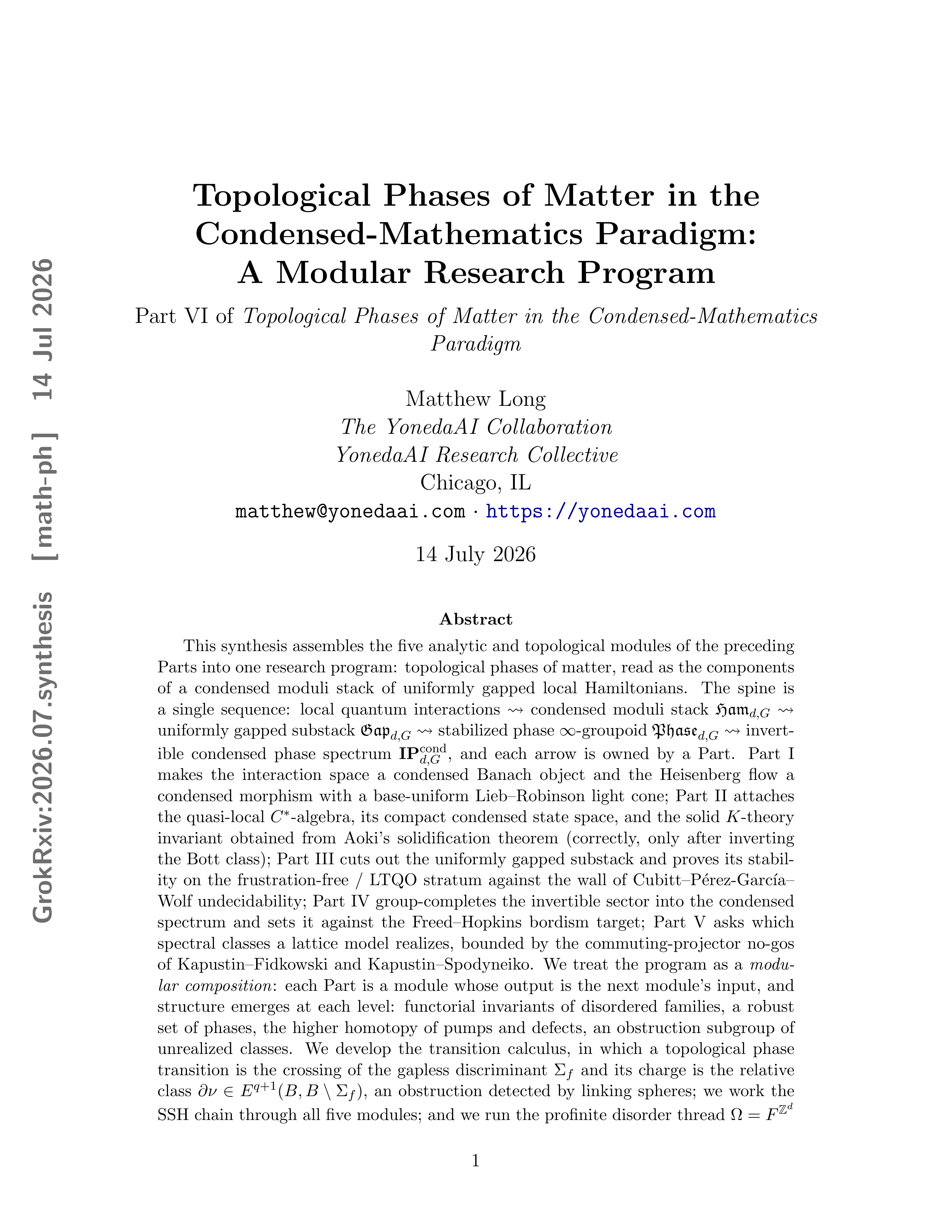
Topological Phases of Matter in the Condensed-Mathematics Paradigm: A Modular Research Program
The capstone: composing all five modules into one spine from local interactions to the invertible condensed phase spectrum.
The five modules
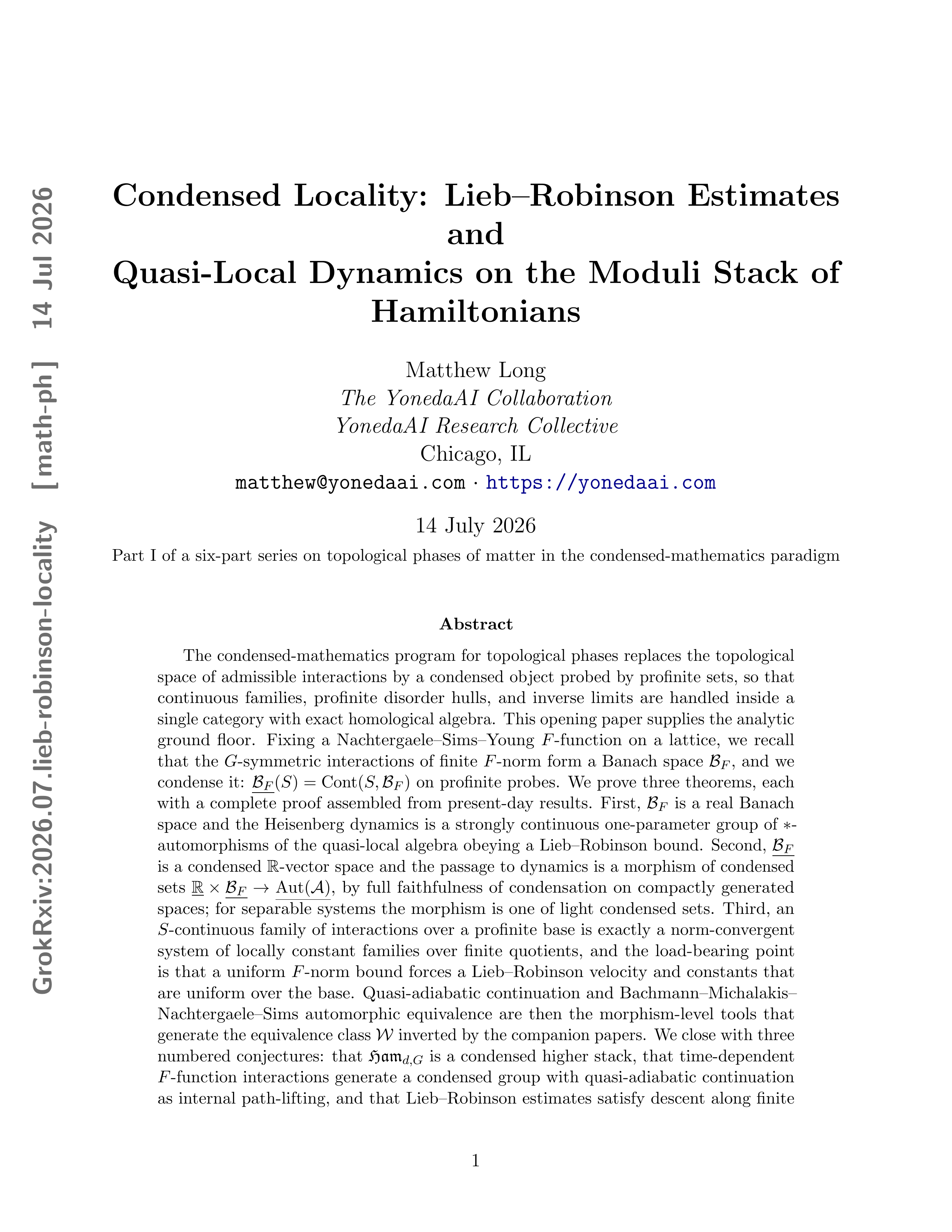
Condensed Locality: Lieb–Robinson Estimates and Quasi-Local Dynamics on the Moduli Stack of Hamiltonians
Condensing the space of quasi-local interactions and proving a uniform Lieb–Robinson bound over profinite families of Hamiltonians.
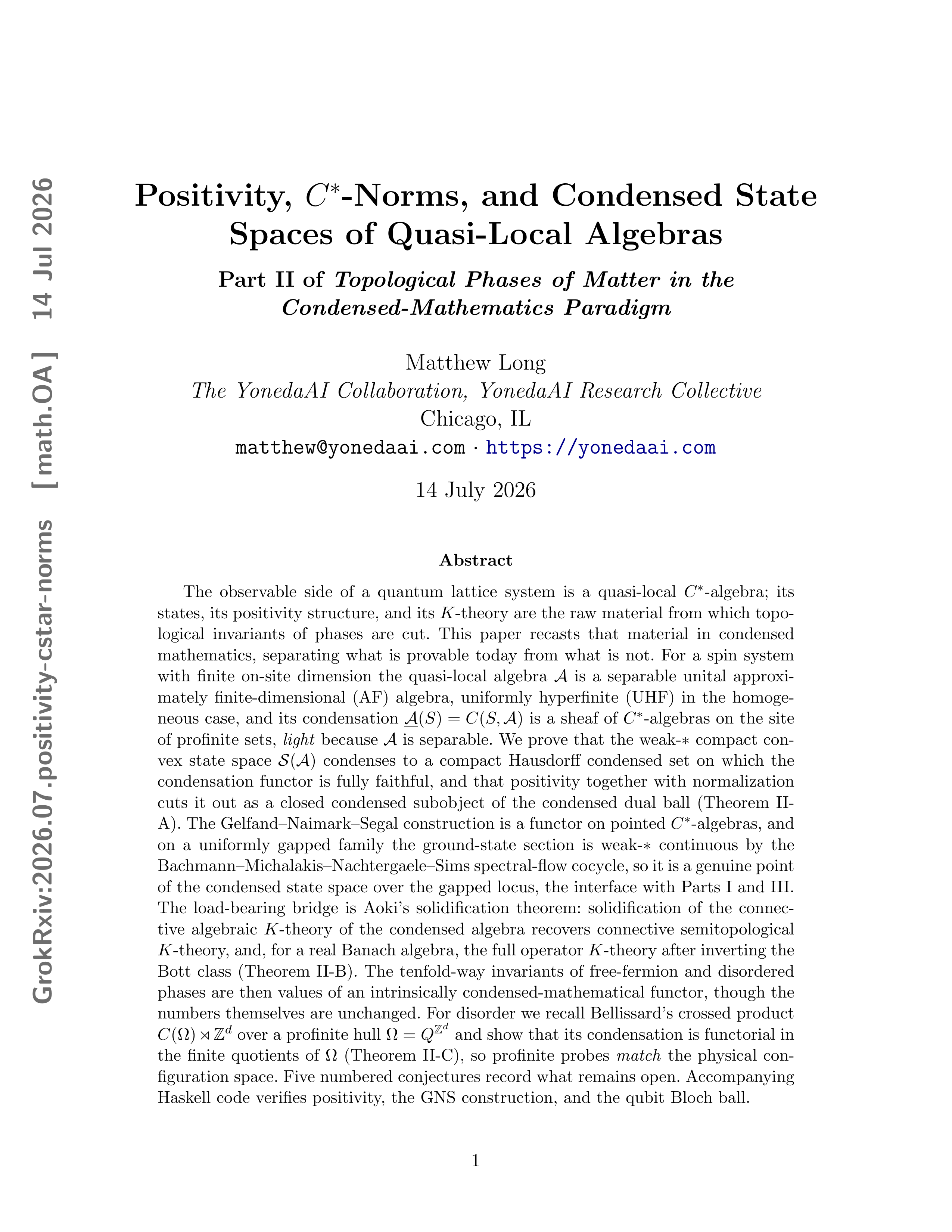
Positivity, C*-Norms, and Condensed State Spaces of Quasi-Local Algebras
Quasi-local C*-algebras, condensed state spaces, and the solid K-theory invariant built from positivity and GNS representations.
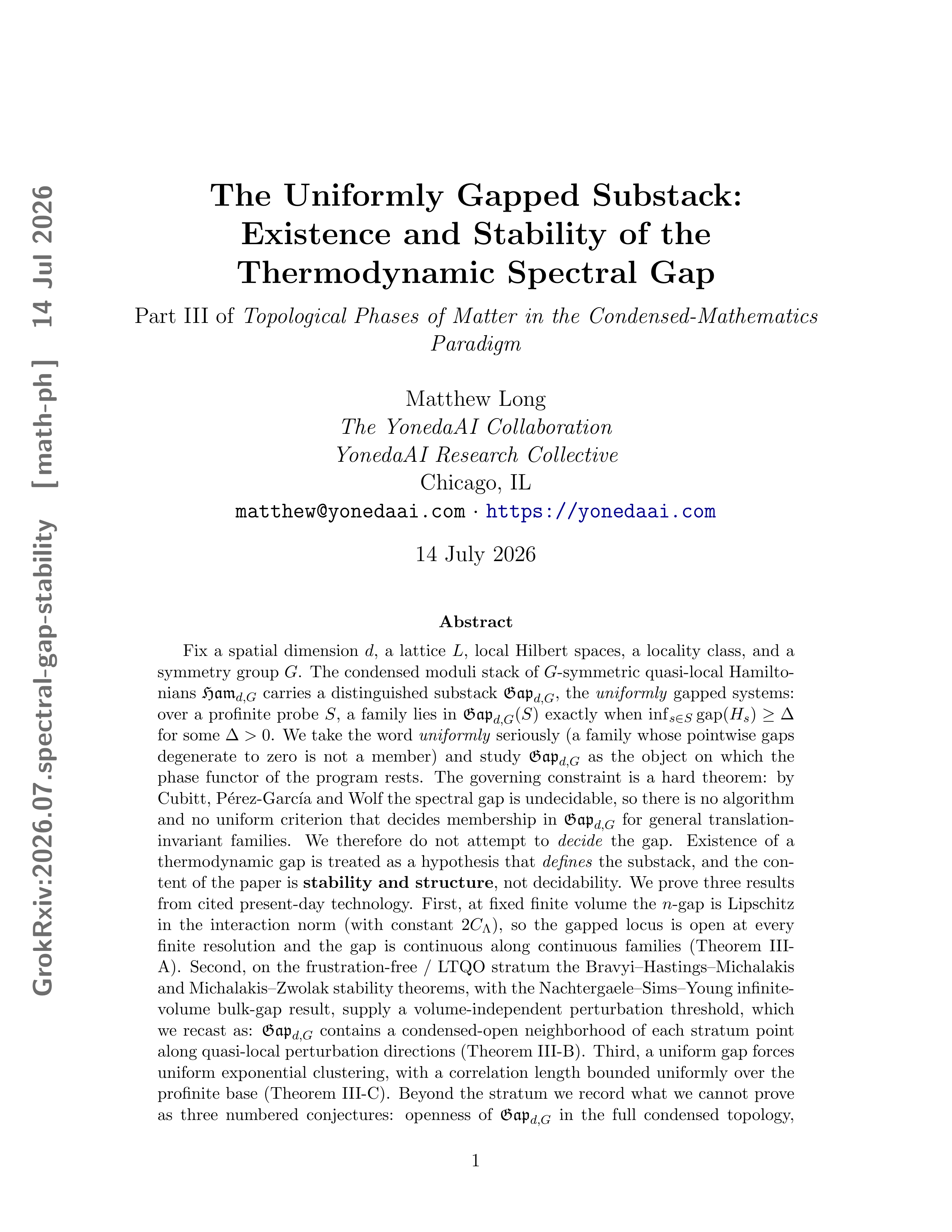
The Uniformly Gapped Substack: Existence and Stability of the Thermodynamic Spectral Gap
The uniformly gapped substack of the moduli stack of Hamiltonians: existence, stability, and the undecidability wall at its edge.
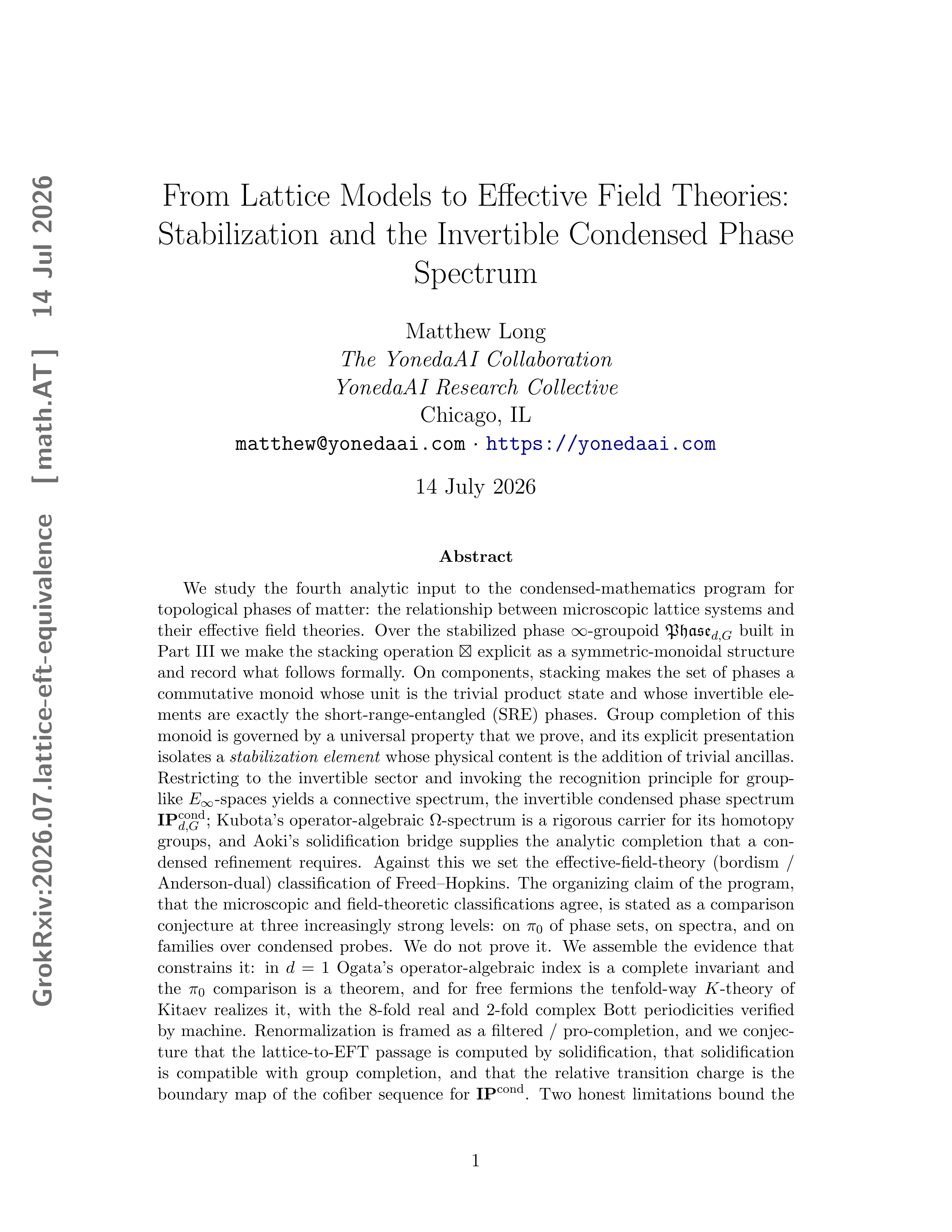
From Lattice Models to Effective Field Theories: Stabilization and the Invertible Condensed Phase Spectrum
Stacking phases into a commutative monoid and group-completing it into the invertible condensed phase spectrum IP^cond.
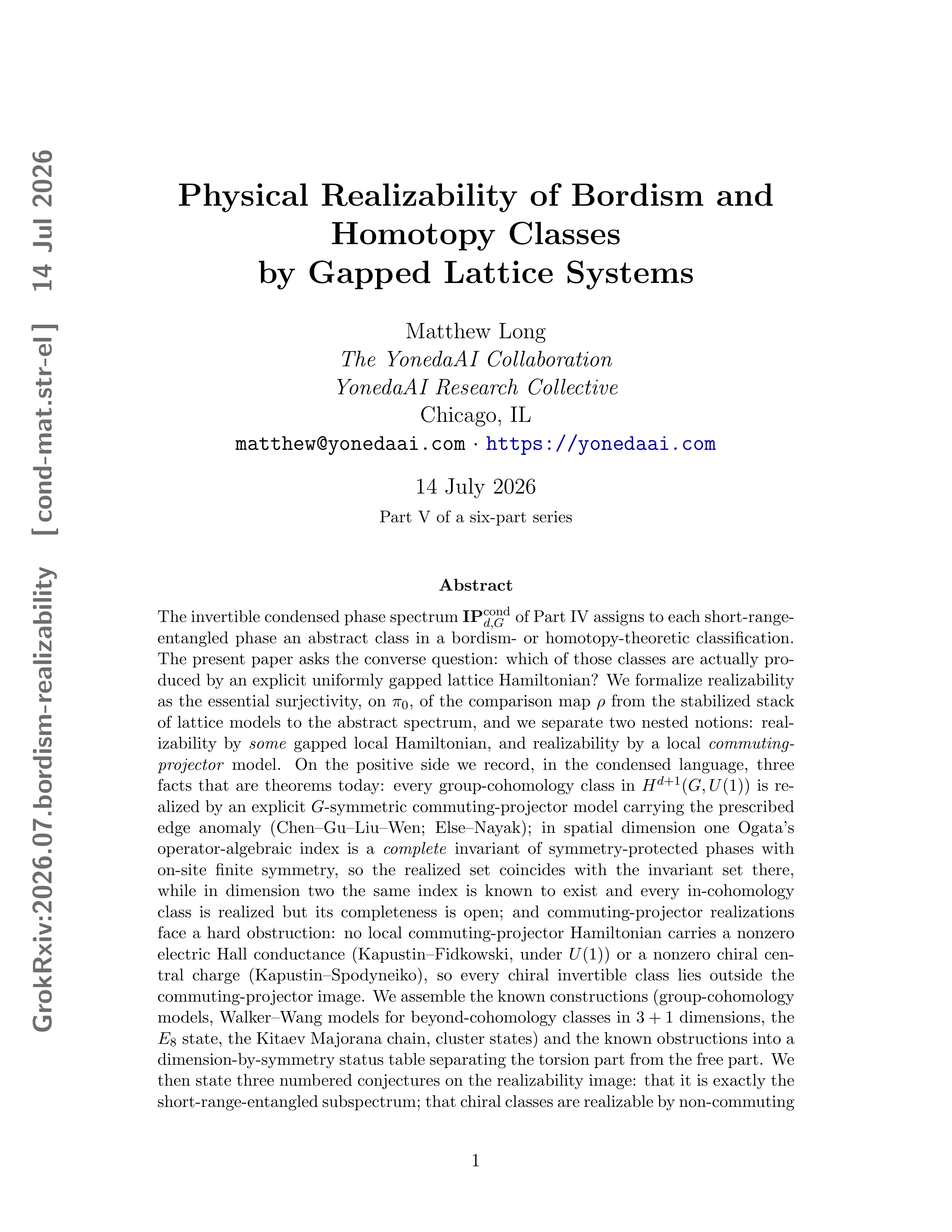
Physical Realizability of Bordism and Homotopy Classes by Gapped Lattice Systems
Which bordism and homotopy classes in the invertible phase spectrum are actually realized by explicit gapped lattice Hamiltonians.